

This is How We Lose
How Today’s Oral Arguments Become Tomorrow’s Decisions, How Their Decisions Become Our Story, and How to Make a Big Announcement at the End of a Substack Article

Today, the Supreme Court heard oral arguments on their final scheduled LGBTQI+ rights case of the term. It was a grueling three and a half hours, with stellar showings from attorneys at the ACLU and Lambda Legal. And still, it wasn’t enough to make the opposing counsel - or several of the justices - even refer to trans girls as girls. Every time our side offered nuance and precision, their side let swing a wrecking ball. It didn’t bode well.
But we knew that was going to happen.
After several hard-won decades of historic wins has come several rapid-fire years of hard losses, particularly for transgender people. Those wins and losses don’t determine who we are or whether we exist. It’s also true that some number justices with significant power over the material conditions of our lives likely think they do. Hard or historic, a handful of cases the Supreme Court will decide this term are going to have significant implications for the rights of LGBTQI+ people, particularly those of us who are transgender. But history is here to remind us it’s the hard moments that turn out to be the important ones.
We who have been working in civil rights law and advocacy a long time know, or should know, that how we talk about loss in the days to come matters. For some years I had the honor of serving as both the Executive Director of Trans Lifeline and the Director of Advocacy and Government Affairs at The Trevor Project. I can guarantee the volume of calls to their crisis lines in the days following the decisions in the months ahead will depend, at least in part, on how we tell our own story and how we model integrating new developments into it. Especially to people whose first introduction to these cases may be the headlines announcing the decisions. Especially to LGBTQI+ youth whose sole information about how they should be processing the news comes from bloggers and influencers.
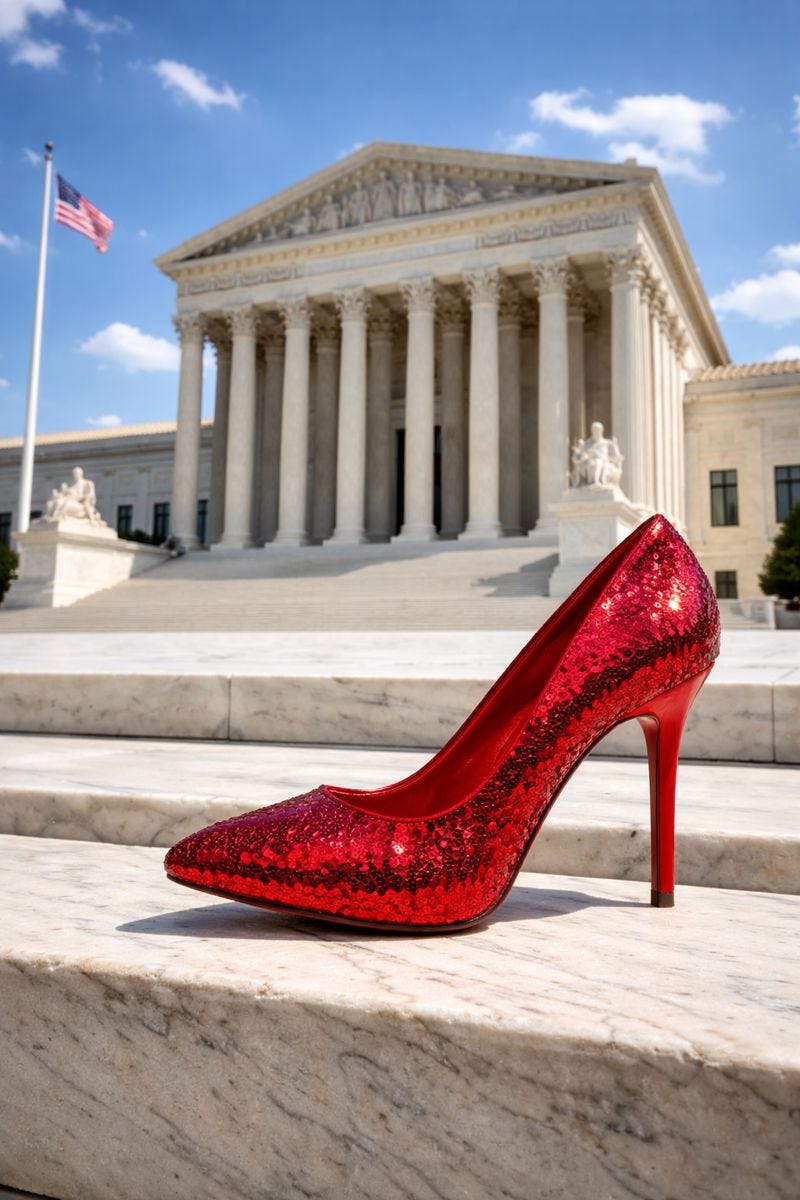
Will we tell them this is a catastrophic blow causing irreparable harm from which people like them will never recover? Will we tell them to get up from the mat and shake it off? Or will we tell them that grief is something queer people have distilled into power for generations - that the legacy our ancestors carved from brick with broken nails and sequined stilettos is that we use that power to take care of each other?
I want to start by saying three things I think are true.
First, let’s rip off the band aid. Despite having some of the best lawyers in the world, it is likely we are going to lose these cases.
Second, queer people are too powerful to be destroyed by something as perennial as loss.
Third, how we talk about loss – both to those who would cause it and those onto whom it will fall most heavily – shapes how we conceive our future. For too many, it also shapes whether the future is worth conceiving at all.
In moments like this, I tend to think that it’s natural to both overreact and underreact. When everything feels like catastrophe, panic can feel like resistance. But I’m a big believer that the best antidote to panic is information, and the best resistance is community care. So let’s start with what’s at stake this Supreme Court term and what isn’t.
Sports, and Then Some: Little v. Hecox & West Virginia v. BPJ
Today, the Court heard what is likely - but not guaranteed - to be its final oral arguments on LGBTQI+ rights this term. In the days to come it will consider whether the Equal Protection Clause and Title IX allow states to issue blanket bans on trans (and likely also intersex) people playing sports on the teams that make sense for them, rather than requiring basic guardrails that take individual circumstances or the possibility of invidious discrimination into account. We are, in the current political conversation, a little bit allergic to nuance.
The direct impact of this case won’t be enormous. Despite the salacious, transphobic, and frequently racist headlines raising alarms that scores of trans women are dominating sports, the law at issue in BPJ only ostensibly applies to one trans athlete who wants to compete – because the plaintiff in the case is literally the only known one in the state.
What’s more dangerous is the possibility that the justices will use the pretense of concern about women’s sports as an opportunity to go further down the Equal Protection analysis than they have in the past. Last summer, when it ruled that states could restrict healthcare for trans youth in United States v. Skrmetti, the Court continued a long history of sidestepping the question of where LGBTQI+ people fit into this line of constitutional questioning.
This time, the justices could choose to rule once and for all whether discrimination against trans people falls under the Court’s skepticism of laws that treat people differently based on sex. They could also choose to rule on whether, regardless of the relationship between sex and gender identity, laws discriminating against trans people themselves warrant a different degree of scrutiny than laws that treat people differently based on more innocuous things, like occupation. Or they could skirt the question altogether and find a way to decide the cases without answering it.
If we lose under the current makeup of the Court, we’re rooting for Door #3. For what it’s worth, given two opportunities in four years, that’s exactly what it has done. But we’re living in a more hostile world than we were even a year ago. It’s possible this could be a broad decision, and it’s possible it could set back the movement for formal legal equality decades.
The key phrase in that sentence isn’t “set back the movement”; it’s “formal legal equality.” This is a potential legal loss, and we as a community will rightfully grieve it and the circumstances from which it arose. But it’s not an existential one, and it’s not one from which we will never come back. LGBTQI+ people have spent most of history without formal legal equality, and we have never not existed. We have loved each other through it, and we have turned that love into advocacy for the rights and dignity of the people we call family.
Law is not liberation. Equality is about other people. Community is about us.
Conversion Therapy, and Probably Professional Speech Too: Chiles v. Salazar
In October, the Supreme Court heard oral arguments in a case about whether the First Amendment prevents states from banning licensed mental health professionals from practicing conversion therapy on LGBTQI+ youth. The justices gave some signals during the arguments that didn’t inspire optimism. It’s looking very possible that they will decide to overturn twenty-three state laws (and one in D.C.) prohibiting conversion therapy. It’s also possible they will unintentionally overturn a whole host of rules preventing licensed professionals writ large from giving really, really bad advice. But it seems that’s a later problem.
Because this happens to be the issue on which I spent the first four years of my legal career at the Born Perfect Campaign, it hits particularly close to home. It means I know this national effort has saved lives, because I know their names. It also means I know the goal of this nationwide campaign was never just to pass a few dozen laws. The laws were always one part of a much larger strategy.
The truth is most conversion therapy doesn’t take place in an office subject to state regulation. What the laws at issue apply to is the comparatively small percentage of it practiced by a licensed mental health provider, subject to specific ethical standards of care, acting in a professional capacity, with a patient under 18. The law at issue in this particular case has been enforced so rarely that a major point of contention is whether the plaintiffs have standing to challenge it at all, considering the state’s admission they have no intention of ever enforcing it.
In 2012 when we passed and defended the first of these laws, California’s SB 1172, it was an opportunity to educate people about conversion therapy and convince them it was dangerous at all. Back then, there was a thriving industry built on convincing parents who loved their kids and were scared for their future that there was an easy fix for their sleepless nights. If you googled “conversion therapy,” you got a list of conversion therapists.
Go google “conversion therapy.” I’ll wait.
…
*acid jazz hold music*
…
If what you saw on the first page of search results was an uninterrupted list of statements from major medical and mental health organizations that these are dangerous, discredited practices, the strategy worked. Don’t confuse the ends with the means. Yes, we may lose this case. Yes, the Supreme Court may invalidate a set of narrowly-written laws we nonetheless worked our hearts out to pass. But it won’t erase the years of organizing, advocacy, and education built around them or the community that formed in their wake. It won’t un-save lives.
Law is not liberation. It’s a tool.
Passports, and the Rest: Trump v. Orr
Finally, it’s possible the shadow docket could again play host to procedural questions arising from the case the Court faced this fall over passports, or the battles over any number of our other basic rights. As a reminder, valid passports remain valid, including those with past name or gender changes and including those with X gender markers. The only thing on hold after the decision this fall is applications for new passports. But the Court didn’t give great reason to believe that, if and when the merits of the underlying case make their way back up, it will rule in favor of trans applicants.
These cases are designed to be fast-tracked, and it’s harder to predict when and where they’ll show up. Breathing through uncertainty in the meantime isn’t easy. At this point we should all probably have a healthy a meditation practice. But the Trump administration has shown a particular penchant for using the shadow docket, so it’s important that we’re keeping up with their legal strategy as we craft our own, legal and otherwise.
Because, say it with me: Law is not liberation. Even if we win every case, even if we knock down every procedural curveball they throw at us, the work of justice will not be done.
What Comes Next
I’d be remiss if I didn’t say it’s possible I’m wrong. In 2020, I thought we would lose Bostock v. Clayton County, and we won 6–3, so what do I know. It’s possible we win every case before the Court. It’s possible that, for a moment, law and liberation collide. To paraphrase the Dread Pirate Roberts, anyone who tells you they know what the Supreme Court is going to do is selling something. That goes double for bloggers and influencers.
It’s with this in mind that I’ve decided to become one of those bloggers. Less so an influencer – I don’t have the first clue how to contour a jawline.
But I do have a Substack, a head for law, and a heart for liberation. So in the days to come, I’m going to be writing a bit about what’s happening at the Supreme Court, what you’re likely to hear about it, and why those aren’t always the same thing. I’m also going to talk about common questions from both sides about LGBTQI+ issues, the substance of the law and the strategy of how we use it, queer history, and even a little theology. Yes, theology. I promise to make it fun, and to only blaspheme a little.
So, if you’ve ever read a post I wrote on social media or a piece in Medium or an op-ed in some news outlet, and something I said resonated, I hope you’ll hit the free subscribe button below. (I won’t say no to you hitting the paid subscribe button either, but I won’t ever put anything behind a paywall – hitting it just helps make the work I do in the world a little more sustainable.)
If we’re going to lose, there’s no one I’d rather lose with. Arm in arm, sequin to sequin. I hope you’ll stick around.
A lawyer with a chaplain’s heart
I feel this so much, especially the generational component of it - those who have grown up / come out post-Dobbs don't have the lived in experience of being queer and happy without any social recognition. It certainly is better to have legal rights, but it does not erase us, or take away our joy, despite what some may wish.